Thursday, April 5, 2007

Sportolysis - The World Sports Blog » Blog Archive » The isolation of Bhavik Gandhi


Why should we know of Bhavik Gandhi?

From his site:

Bhavik is attempting to row 3000 miles (5000 km) across the Atlantic Ocean From Spain To Antigua. He will row solo and unsupported, in a 23ft rowing boat, spending an estimated 90 days at sea.

If he succeeds, he will;

• be the first Asian to ever complete a solo ocean crossing
• break the existing record set by Emmanuel Coindre of France
• be the 32nd person to ever achieve a solo Atlantic crossing

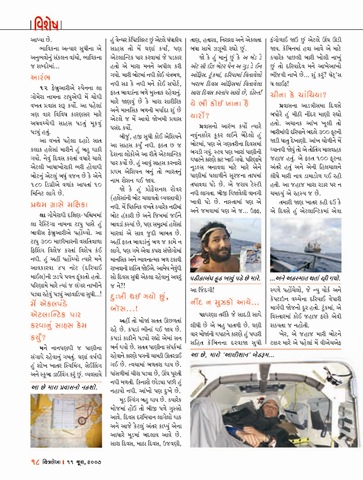
Sadly, the Indian media has been completely ignoring Bhavik Gandhi. A quick google news search yields no results.

Debi Taylor from Australia emails me:

I was Googling around to see if I could find out some more information about a great Indian sportsman, Bhavik Gandhi who is currently rowing solo across the Atlantic Ocean, and I believe is the very FIRST Indian EVER to do so! However, I found it disappointing that I have not see any articles on and Indian news wesbites or on blogs and was wondering why this is?

The Indian fans have shown inelastic demand for cricket in the past and no matter what happens, they follow cricket. The Indian media, as a result of it, keeps tracking cricket. So, the cricket team is hyped before the World Cup and even after a poor performance, it hogs the limelight with focus on Chappell one day, Tendulkar on the other. Despite being a huge sports fan and despite following sports news items, I didn’t even know regarding Bhavik Gandhi’s pursuit before Debi emailed me.

The Indian fan has to show an inclination to other sports and the viewership has to drop in the upcoming Indian cricket team’s tour of Bangladesh. Side by side, the media should try to make most of some thing like this.

The best site right now to follow Gandhi’s progress is Humanedgetech. Hopefully, we will hear more from the media on this in the near future and the Indian fan will show that he can think beyond cricket.

Tags: Bhavik Gandhi, Indian Sports.

Sportolysis - The World Sports Blog » Blog Archive » The isolation of Bhavik Gandhi

Thursday, March 22, 2007

Monday, March 19, 2007

The Tribune, Chandigarh, India - Main News

 070319_tribuneindia

City engineer first Indian to cross ocean in paddle boat
Vijay Mohan
Tribune News Service

Chandigarh, March 18
A 34-year-old software engineer from Chandigarh, Sher Singh Dhillon, has paddled his way into the record books by becoming the first Indian to cross the Indian Ocean on “human power”. As part of a global circumnavigation mission called Expedition 360, he traversed the high seas in a paddle boat along with team leader Jason Lewis.

The boat had left the shores of Mumbai on January 29 and reached Djibouti on the eastern shores of Africa today noon after battling winds, waves, ocean currents and other challenges over a 1,835-mile expanse of unpredictable waters for 49 days and nights.

“It has been immensely satisfying and exhilarating to complete a successful voyage cross the ocean,” Sher Singh told The Tribune over satellite phone from Djibouti.“ It’s great to know that you can go just about anywhere on your steam rather than relying on powered transport,” he added.

Expedition 360 is described as an attempt at one of the last great firsts for circumnavigation -- to circle the globe using only human power through bicycle, pedal boat, rollerblades, kayaks, swimming and walking, with no motors, sails or any other powered transport. Three-quarters of the journey, totalling about 35,000 miles, has so far been completed. The expedition had started from Greenwich in Britain 13 years ago and is expected to culminate this year at the same place. Jason is the only person to have remained with the team since its inception in 1994, while different persons have participated in different legs.

“According to records held by the UK-based Ocean Rowing Society, Sher Singh is the first Indian in history to cross an ocean by human power,” Jason said. Sher Singh is presently employed with Hewitt Packard in California. His father, Air Cmde R.P.S. Dhillon, is a retired Air Force pilot settled here. Sher Singh, who periodically visits his parents, is expected here next week.

The 26-foot wooden boat is powered only by pedals and named Moksha, which in Sanskrit means salvation. Specially designed for the expedition, it has ferried members 15,000 nautical miles of the ocean and carries the names on her hull of about 4,000 people who have helped the expedition across the world.

Jason and Sher Singh encountered a number of challenges while traversing the Indian ocean. “On our first day out from Mumbai, we crashed into the unmarked wreckage of a sunken ship, damaging the underside of the boat and destroying the rudder,” Sher Singh said. They limped back to port to replace the rudder.

A week later, their water desalinater conked out and the coast guard arranged to have a passing ship drop off 180 litres drinking water, allowing them to just survive the rest of the voyage. There were two instances when they almost collided with big ships, including a tanker.

“The ocean can be very discerning and unpredictable. Heavy winds threw us off-course several times,” Sher Singh said. “Upon the final approach to the Gulf of Aden, a fierce current pushed us south toward the island of Soqotra, one of the world’s most-feared areas for pirate attacks. Days earlier, a UN cargo vessel was hijacked in the area and the crew kidnapped for ransom,” he added.

The Tribune, Chandigarh, India - Main News

Monday, March 12, 2007

The magazine that puts the fibre into carbon........ News p 6 »

 image

In 1966 David Johnstone

and John Hoare, who were trying to be

the first 20th century Atlantic rowers,

were lost during Hurricane Faith, with

only their 15-foot wooden boat Puffin

found after the storm subsided. Expe-

rienced ocean

rower Graham

Walters recently

found Puffin in

a museum and

decided her unfin-

ished voyage

had to be com-

pleted. On 20th

December four boatsful left San Sebas-

tian de La Gomera to start an east-west

Atlantic crossing in memory of Hoare

and Johnstone. Walters was rowing the

40-year-old Puffin, now refitted, while

Bhavik Ghandi, Victor Gavrishev and Stu

Turnbull/Ed Bayliss were in three more

modern boats, each of the four vessels

sporting a Puffin logo in honour of the

men who were lost.

The modern Puffin contingent set out on

20th December 2006, from La Gomera

harbour, after months of delays. Unfortu-

nately after only 8 hours rowing, the Puf-

fin was stopped by Spanish coastguards,

searched, and impounded when they

discovered some equipment which did

not comply with regulations. A bail of

30,000 euros was set to release the boat,

which was damaged on the way back to

harbour while being towed. Victor Gavr-

ishev and his boat suffered a similar fate,

as did Ghandi, the latter restarting at the

end of February. Turnbull and Bayliss

were too far out to catch when the coast-

guards arrived, and completed the row on

21st February. Walters restarted his row

on February 3rd and is still on the Atlan-

tic. He is gaining inspiration and helpful

hints from reading chapters from Merton

Naydler’s book ‘The Penance Way’ based

on Johnstone’s journal, discovered intact

when the Puffin was found.

February has seen several teams com-

plete rows, apart from Turnbull and

Bayliss. On 26th February Dutchmen

Wendel Rontgen and Gijs Koning landed

in Antigua, on the way resupplying the

famished Turnbull and Bayliss - an ocean

rowing first. The two crews met up on

Valentine’s Day, rendezvous-ing at 17

degrees 20 minutes north, 55 degrees 38

minutes west, transferring much-needed

supplies to the British boat and sharing

The magazine that puts the fibre into carbon........ News p 6 »

Wednesday, February 28, 2007

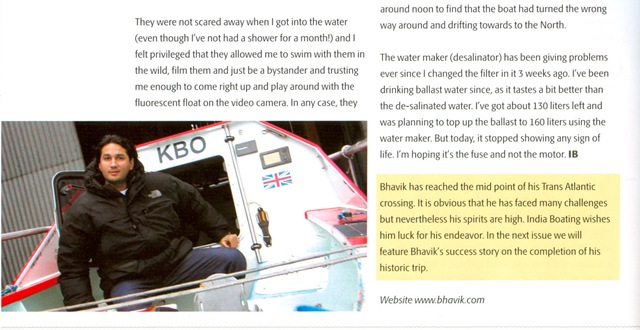
Bhavik Gandhi braving the mighty Atlantic rowing solo, one mile one meridian at a time.

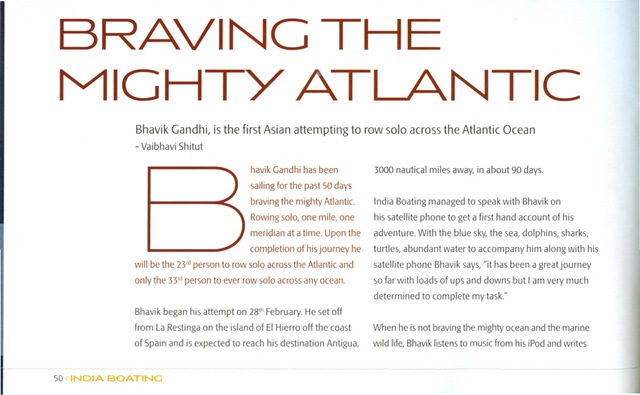
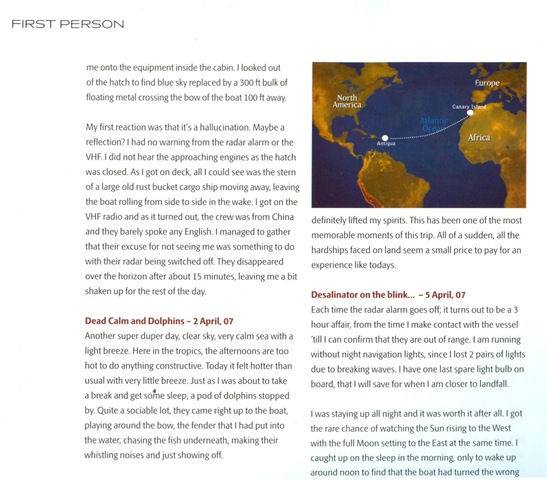
Bhavik Gandhi began his attempt at becoming the first Indian and first Asian to row solo across the Atlantic Ocean on 28th February, 2007 at 1155 hrs GMT. Bhavik set off from La Restinga on the island of El Hierro off the coast of Spain and is expected to reach his destination Antigua, 3000 nautical miles away, in about 90 days.

Bhavik has been at sea for about 35 days now and has already rowed for over 900 nautical miles pushing the boundaries of equipment, body and mind beyond limits unfathomable to most human beings. He hopes that this attempt to row across the Atlantic solo will inspire others to take on challenges and obstacles in their life that were thought impossible and help realise situations are not always as bad as they may seem to be.

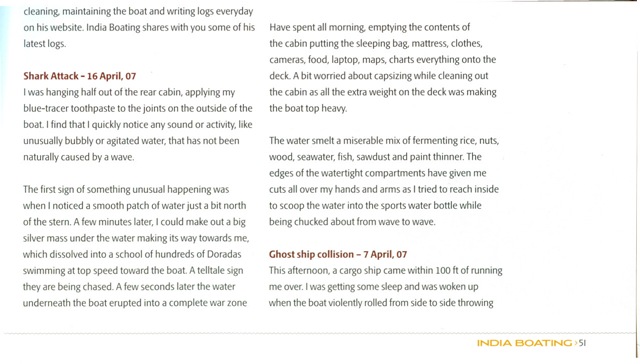
Bhavik in his attempt to row across the Atlantic unaided, is at the mercy of the weather and has to endure extreme conditions such as gale force winds, storms and regular 4-storey high waves in the open ocean, not to mention the constant fear of sharks and whales. Days merge into a big blue background and darkness interspersed with brilliant stars on clear nights are his only friends. However, he is kept amused by the constant shoal of pilot fish and sometimes even dolphins that follow his boat as it continues its journey to Antigua. For more updates on Bhavik’s remarkable journey log on to http://www.bhavik.com/crossatlantic

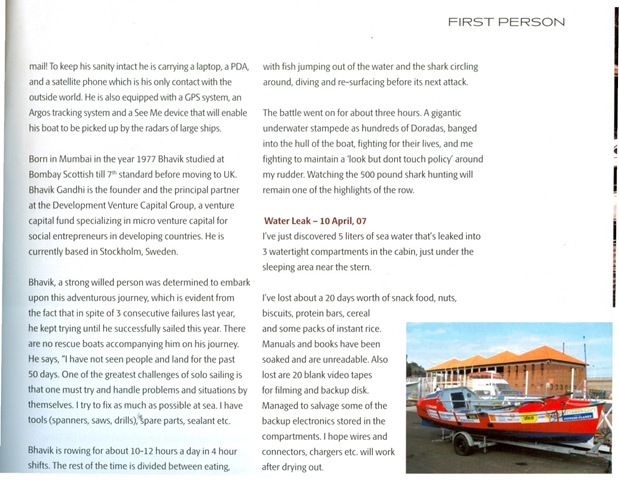
Bhavik is rowing for about 10-12 hours a day in 4 hour shifts. The rest of the time will be divided between eating, cleaning and maintaining the boat, and trying to catch up on some much needed sleep. To keep his sanity intact he will be carrying a laptop, a PDA, an iPod and a satellite phone which will be his only contact with the outside world. He will also be carrying a GPS system, an Argos tracking system and a SeeMe device that will enable his boat to be picked up by the radars of large ships.

Upon completion of this journey he will be the 23rd person to row solo across the Atlantic and only the 33rd person to ever row solo across any ocean. The Ocean Rowing Society would certify the World Records. Following the route Christopher Columbus took, Bhavik will spend an estimated 90 days at sea in a 23 - ft boat, rowing solo and unassisted. Bhavik on route to his world record will be crossing the infamous Bermuda Triangle

Overcoming challenges and obstacles at sea are of a different kind and a lot more difficult. Bhavik commented, ”Rowing solo across miles and miles of ocean pits man against nature and all that she has to offer. Somedays she just beautiful and calm while other days she comes with problems such as rough weather, strong currents which push a person to and beyond boundaries they never knew existed. That is the biggest battle of them all. I have to get miles out of nature by pushing the boundaries of the equipment, body and mind. I have been preparing my self for this my whole life with the intense physical and mental and emotional training I have put myself through.”

About Ocean Rowing:

Ocean rowing remains the world’s toughest human powered endurance sport. Relying on muscle-power alone athletes row in extreme weather conditions across the open ocean facing 40 - ft. waves. This sport is unique in terms of its difficulty, exceptional length and demands on physical and mental endurance. Extensive planning, preparation, motivation and persistence are a pre-requisite.

The sport is as much a psychological as it is a physical challenge. Rowers often have to endure long periods at sea with help often many days if not weeks away. The challenge is especially acute for solo rowers who are held in especially high esteem within the sport. The history of ocean rowing is sometimes divided into two eras. The first 12 ocean rows are considered "Historic Ocean rows" within the sport as they were completed with very limited if any modern technology

About Bhavik Gandhi:

Bhavik Gandhi is the founder and the principal partner at the Development Venture Capital Group, a venture capital fund specialising in micro venture capital for social entrepreneurs in developing countries. His present work also involves investments in high growth startups specialising in Next Generation Network technologies, for converged voice, video and data services for fixed and wireless telecommunication carriers. Bhavik's experience spans Telecommunications, Retail, New Media, Venture Capital, Energy, Outsourcing and the non-profit sector. He has also had extensive experience in the establishment, growth and management of startup companies.

He is currently based in Stockholm, Sweden. Bhavik holds an MSc in Engineering Information Systems from the Royal Institute of Technology, Sweden and a B.Sc in Management & Information Systems from Royal Holloway, University of London. He was born in Bombay in 1977 and studied at Bombay Scottish, Mumbai till Std. VIII before moving to Sri Lanka and the United Kingdom for further studies.

For further information please contact:

Ryan Marshall – 9871597749, ryanmarshall.office@gmail.com

Monday, January 1, 2007

Zeeman Ocean Challenge rowing expedition

image 

While Ralph and Mike are making the boat ready for its next nine-month-long adventure, a real tragedy has taken place on their point of departure, the island of La Gomera. We wrote in the article "New adventurers check in" on the 20th of December (see the Archive if you want to reread this article) that no less than four rowing boats had departed from La Gomera to cross the Atlantic Ocean: Graham Walters from England in the historic vessel 'The Puffin', Victor Gavrishev from Kyrgyzstan, Stu Turnbull and Ed Bayliss from England and Bhavik Gandhi from India. Just eight hours into their separate journeys, three of the boats were boarded by the coast guard and forced to return to La Gomera, after which the boats were impounded. Only Stu Turnbull and Ed Bayliss managed to escape the long arm of the Spanish coast guard as they were already too far from the coast (these men are rowing to set a world record and had therefore left at great speed).

Why the Spanish coast guard got involved remains unclear; in any case it was against the rowers'Â will. Bhavik Gandhi has written the following on this subject on his website:

"I cannot speak much right now. Enough to say that I am having more problems that I would have liked at the start. First the rudder, and then the coastguard. Will write more soon here in the following days. For now, in port for repairs. It was impossible to fix at sea. More on the coast guard issue shortly. I cannot state more at present. We have the Embassy and the lawyers dealing with it."

Graham Walters was more forthcoming. On his website he mentions 'some equipment' which was on board and shouldn't have been - or perhaps which wasn't on board and should have been, it's not that clear. He also reports that the coast guard towed the boat back to La Gomera at high speed, causing serious damage to the rowing platform.

All in all it's a sorry state of affairs for these adventurers, who have been working for years to achieve their dreams and are now seeing all their work come to nothing. Especially for Graham and Bhavik, as they have already had to abandon one attempt to row across the Atlantic Ocean. We hope things start to look up for you, guys!

Zeeman Ocean Challenge rowing expedition